Ever since becoming a leader my North Star has been velocity. Each day I’ve tried to optimize sprints, CI/CD pipelines, and stand-ups to solve one problem: how do we ship faster? Now, I’m staring at a world where AI might actually give us what we asked for. But as I watch our teams start to lean into these tools, I’m beginning to suspect we’re heading toward a different kind of disaster.
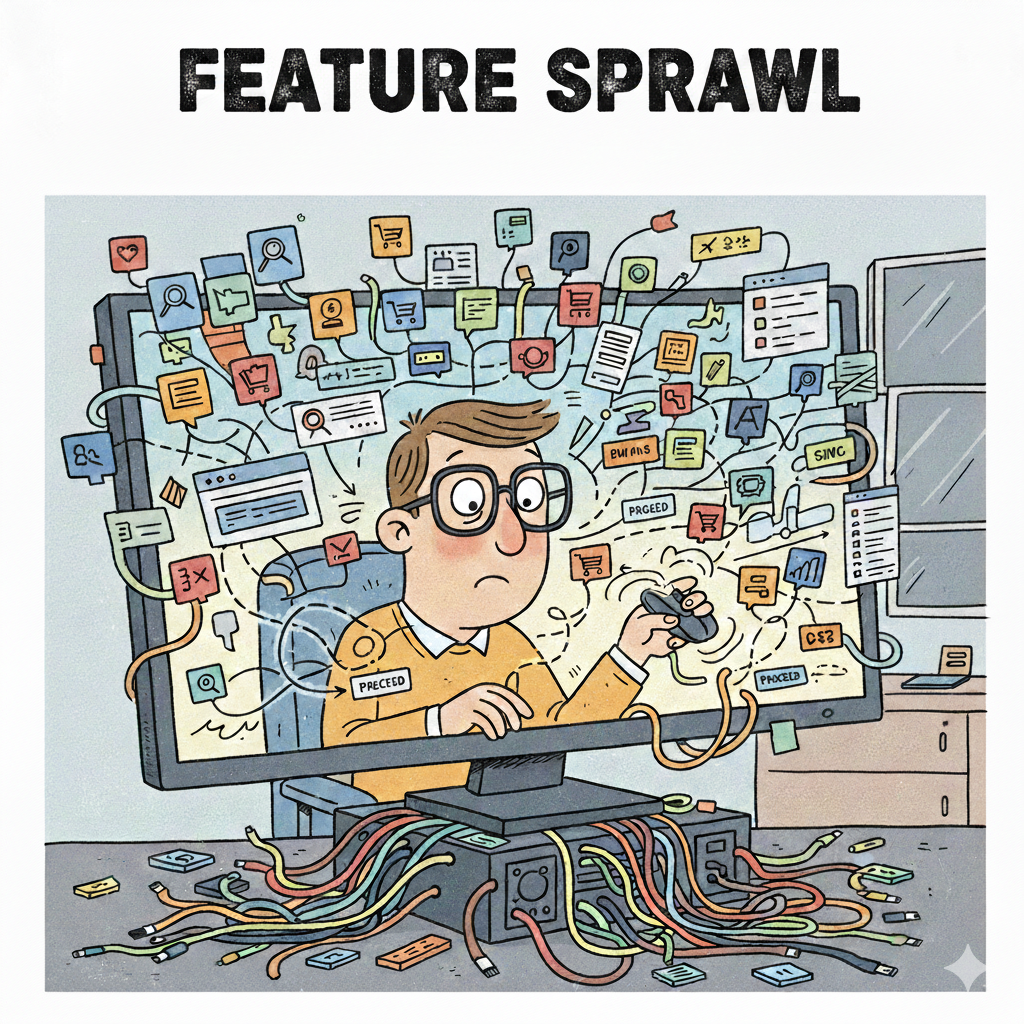
My prediction: We are about to enter the era of products plagued by feature sprawl.
The “Cost of Yes” is Bottoming Out
Historically, engineering friction was a natural filter for product quality. Because code was expensive and slow to write, we had to be ruthless about what made the cut. We debated every setting, UI button, and every API endpoint because we only had so many hours in a sprint.
But I’m seeing that friction start to evaporate. When AI makes it trivial to spin up a new module or a “quick” feature add-on, the organizational impulse won’t be to simplify - it will be to expand.
I think we’re going to see products go wide instead of deep. We’ll see a massive acceleration in feature creation, but I fear it will come at the expense of a cohesive user experience. We’re going to build a lot of “stuff” simply because we finally can, without realizing we’re burying our core value proposition under a mountain of AI-generated noise.
The Orchestration Gap
Here’s what I’m watching for: a growing gap between Feature Velocity and Product Cohesion.
If we can suddenly generate features 5x faster, but our ability to orchestrate them into a unified, user-friendly experience stays at the same 1x pace, the math just doesn’t work. We’ll end up with “Frankenstein” products - collections of features that work individually but feel disjointed and bloated as a whole.
For those of us in leadership, I suspect our roles are about to shift fundamentally. We won’t be judged on how much our teams produce - AI has turned that into a commodity. Instead, I think we’ll be judged on our ability to curate a cohesive product.
What I’m keeping an eye on:
-
The “No” Muscle: Will we have the discipline to say “no” to features that are “free” to build but “expensive” for the user to understand?
-
The New Technical Debt: I suspect we’re going to see a new flavor of debt - not just messy code, but “Cohesion Debt.” It’s the cost of having 50 features that don’t talk to each other or multiple ways to do the same thing.
-
The Role of the Engineering Manager: I’m betting the most successful Managers of the next two years won’t be the ones with the highest velocity metrics. They’ll be the ones who act as “Product Orchestrators,” ensuring that every line of AI-assisted code actually belongs in the same universe.
Let’s see how it shakes out
I don’t have the data to prove this yet - none of us do I suspect. But the trajectory feels clear. We are solving the “delivery” problem only to create an “integration” nightmare. It’s also not clear to me if it’s Engineering Managers who plug the gap, Product Managers, User Experience, or a mix of everyone. My gut tells me the lines between these roles could blur further - let’s see!
Are you seeing the early signs of this “feature sprawl” in your own orgs? How are you planning to keep your product from becoming a junk drawer?