As I work through another planning cycle, the ritual remains the same: the spreadsheet opens, the roadmap is prioritized, and we start the negotiation for more “heads.” In my world, and likely yours, the engineer has always been the fundamental unit of progress. If we want to move faster, we hire more of them.
But this year, the math feels… off. I’m asking myself - do I really need a new hire for this or do I just need a larger token budget?
We are moving away from a world of Fixed Labor and into a world of Variable Compute. When you hire a Senior Engineer, you’re buying a long-term asset. You’re also buying a 6-month onboarding lag, a management overhead, and a permanent line item on the P&L.;
When you “hire” tokens you’re buying instant, fractional capacity. If your engineers are telling you they can automate 30% of the “toil” using a custom-tuned model, the traditional argument for that extra engineer disappears. We are moving from mere management to true resource orchestration, balancing human architects with pure compute power.
The Shadow COGS and the Entry-Level Gap
This transition isn’t without significant risk. Depending on your organization, you might only see your HR costs; the cost of tokens may be centralized elsewhere, masking the true COGS (Cost of Goods Sold) for your team. Beyond the budget, there are two existential threats to the traditional org chart:
-
The Context Ceiling: AI is a world-class executor but a mediocre architect. You buy tokens for the “What” (the code), but you hire humans for the “Why” - the strategy, the empathy, and the organizational alignment.
-
The Junior Pipeline Crisis: If we replace all entry-level headcount with tokens, we aren’t just saving money; we are eroding our talent pipeline. If nobody is doing the “easy” work today, nobody will be qualified to do the “hard” architectural work in five years.
The New Managerial Playbook
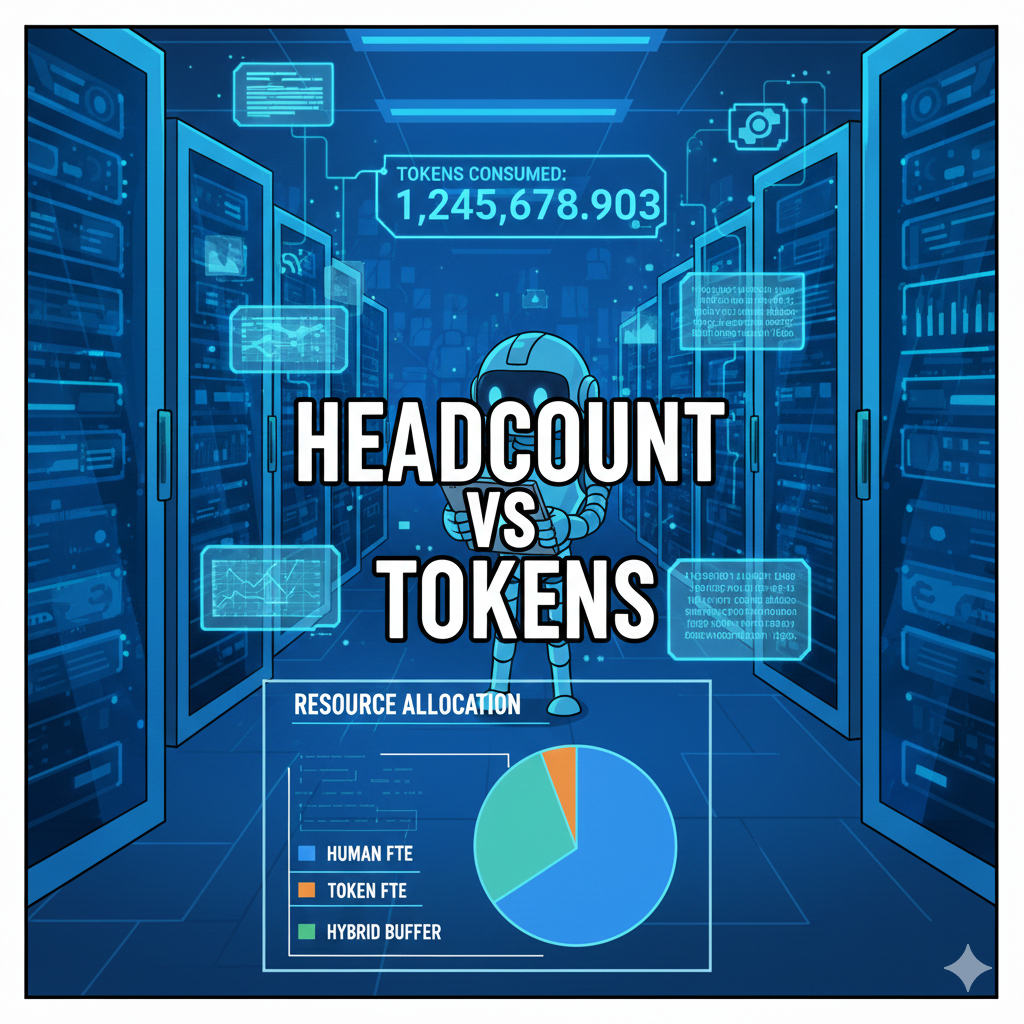
As I’m sitting down to plan the next quarter, I’m adding three columns to my planning template to build a Hybrid Resource Plan:
-
Human FTE: Reserved for high-ambiguity, high-leverage, cross-functional and strategic architectural work.
-
Token FTE: Dedicated to repetitive, high-volume, and well-defined execution tasks.
-
The Hybrid Buffer: A “flex” budget that allows my leads to choose between hiring junior engineers, or lean into a compute-heavy automation strategy mid-quarter.
We are no longer just “People Managers.” We are becoming System Architects. Our job is to orchestrate a hybrid workforce where the “org chart” includes both people with names and models with versions. The goal remains the same: to deliver on business goals effectively by leveraging every resource available to us. The next time one of my managers asks me for an extra new hire for a roadmap item, I’m going to ask them “if I gave you another $50k in API credits, could you make that roadmap item happen?”. I’m curious to see what they say, and if they’ll still give the same answer 6 months from now.
How are you working through this? Are you further ahead in this evolution? If so, any tips to help others navigate?