The 1:50 Ratio: Is the “Pod” Dead and the “Horde” Rising?
For decades, the “Rule of 7” (plus or minus two) has been the gold standard for engineering management. The logic was simple: a manager’s cognitive load is consumed by the complexity of human synchronization. Beyond 8 or 10 reports, you aren’t managing; you’re just treading water.
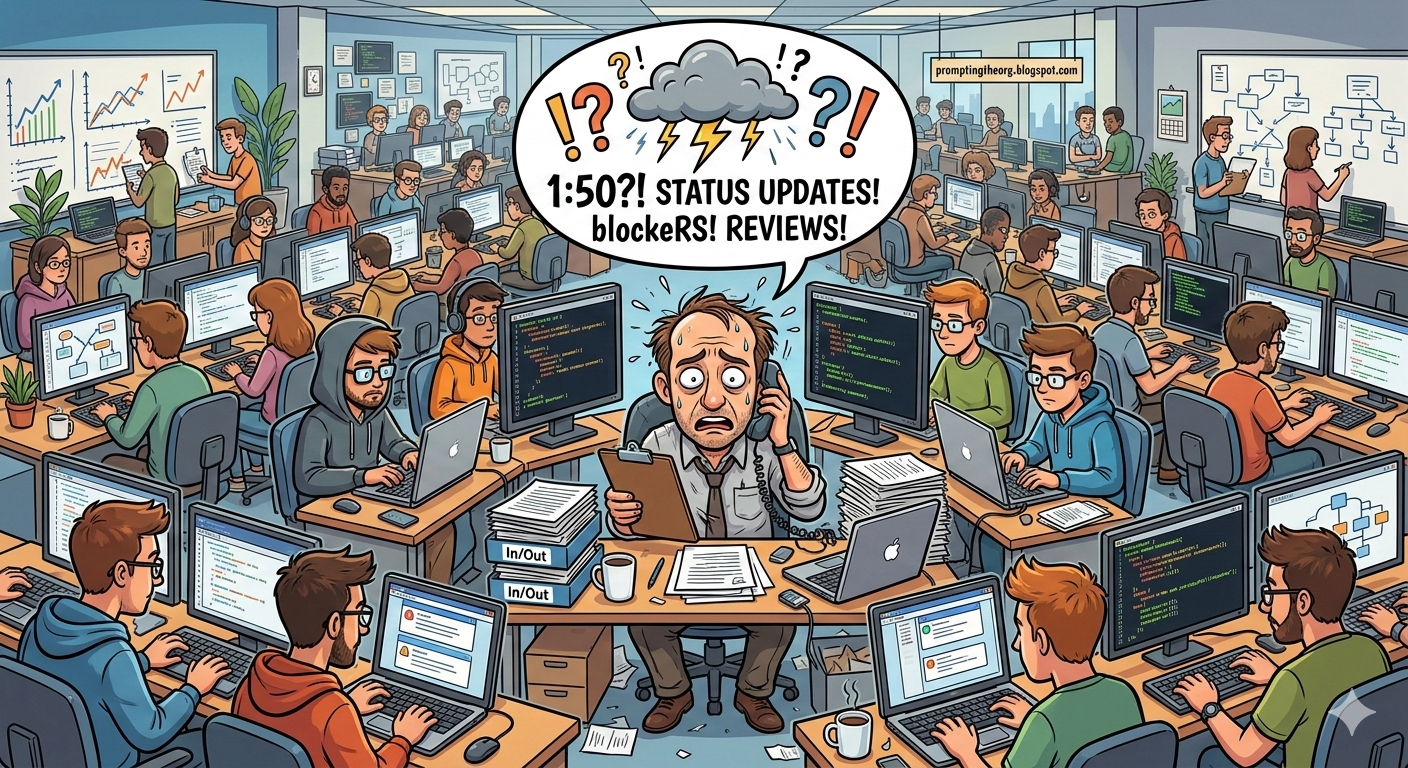
But as AI begins to act as a “force multiplier” for both code and coordination, we are seeing the emergence of a radical theory: The 1:50 Ratio. For example Meta just announced their new applied AI Engineering org with plans for a single manager to manage up to 50 engineers.
Why the Span of Control is Stretching
Why could a manager suddenly oversee 50 souls instead of 10? It’s not because managers are getting smarter; it’s because the overhead of management is being automated.
-
Automated Context: AI agents can now summarize PR cycles, flag blockers in Jira, and synthesize Slack sentiment. The “status update” meeting is becoming an artifact of the past.
-
Self-Healing Teams: When AI assists with onboarding and documentation, the “Junior” developer requires significantly less hand-holding from a human manager.
-
The Death of Coordination Headwinds: Much of a manager’s job is “translation” - moving info between stakeholders. As LLMs become the interface for project data, the need for human translators diminishes.
The Upside: Leaner, Faster, Flatter
A 1:50 ratio isn’t just a cost-saving exercise; it’s a velocity play.
-
Reduced Silos: With fewer managers, there are fewer “kingdoms”. Information travels horizontally across the 50-person group rather than up and down a fragmented hierarchy.
-
Radical Autonomy: You cannot micromanage 50 people. This forces a culture of high agency. You manage by outcomes, not by activities.
The Trade-offs: What Do We Lose?
Before we fire the middle management layer, we have to acknowledge the “Human Debt” this creates:
-
The Mentorship Gap: AI can tell you how to fix a bug, but it can’t navigate your career burnout or help you handle a difficult peer.
-
High-Stakes Failure: In a 1:50 model, a single “bad hire” or a toxic personality can drift for months before a stretched manager notices the rot.
-
The Loss of Nuance: Management becomes statistical. You start managing a dashboard of metrics rather than a group of individuals.
The Great Fork: The Manager’s Ultimatum
If the 1:50 ratio becomes the industry standard, the “Generalist Engineering Manager” is a dying breed. We are approaching a fork in the road where leaders must choose a definitive path:
1. The People Scaling Path (The “Org Architect”)
You embrace the 1:50 ratio. You aren’t a “technical lead” anymore. You are no longer managing engineers; you are prompting the organization - designing the high-level inputs and constraints that allow a 50-person ‘horde’ to self-organize toward a goal. You build systems, culture, and processes that allow large groups of people to thrive without you needing to understand the codebase. You are a coach, a recruiter, and a high-level strategist.
2. The Technical Leadership Path (The “Player-Architect”)
You reject the 1:50 ratio. You stay close to the metal. You manage 3–5 high-performing seniors or AI-augmented squads, but your primary value is architectural integrity and technical vision. You move back toward the “Staff Plus” or “Principal” realm, where your “management” is of the system, not just the staff.
Conclusion: The Middle is a Dangerous Place to Be
Thinking about the future is forcing me to make decisions today. I was considering adding another manager into my org to alleviate a senior manager who had too many direct reports. I paused though, thinking about where we will be in 6 months. I don’t want to hire managers today that I think could be redundant in a matter of months. The “Manager of 8” who spends half their day in meetings and half their day in the code is becoming an expensive bottleneck. As we prompt our organizations into this new era, we have to ask: Are you scaling your people, or are you deepening your craft? Because trying to do both is a recipe for obsolescence.